
VIETNAM

The Private Sector in Vietnam

Vietnam’s private sector has emerged as a dynamic force, driving the nation’s remarkable shift from a state-controlled economy to a vibrant, market-driven powerhouse since the transformative Doi Moi reforms of 1986. With over 940,000 private enterprises and approximately 5 million household businesses, it forms the backbone of local economies, contributing 51% to GDP and employing over 42 million people, 82% of the workforce. Its unique strengths – innovation, a skilled workforce, global integration, agricultural modernization, and high homeownership rate – position Vietnam as a global model for inclusive economic growth.

A major milestone: On July 1, 2026, the World Bank reclassified Vietnam as an upper-middle-income economy – with GNI per capita reaching US$4,970, up from US$4,490 the year before. This achievement underscores the private sector’s central role in Vietnam’s rapid progress.

Core strengths driving success

A high-quality workforce: Vietnam’s exceptional education system produces a highly skilled workforce. In the 2022 PISA assessments, Vietnamese 15-year-olds ranked 31st globally in mathematics and 34th in science. Annually, 50,000-60,000 IT and computer science graduates enter the workforce with skills meeting international standards.

High homeownership offers unique strength: With one of the world’s highest homeownership rates (~88-90%), families can allocate more income to education, entrepreneurship, and consumption. Many use property value to launch or grow businesses. Combined with rapid urbanization and a growing middle class, this drives private sector expansion and economic resilience.

Pioneering innovation and digital transformation: Supported by the 2020 Enterprise Law and Politburo Resolution 68 (May 2025), which names the private sector “the most important driving force” of the economy, Vietnam attracts global giants such as Microsoft, Samsung, and NVIDIA. With nearly 74,000 digital tech firms, the IT outsourcing sector generated $0.7 billion in 2024 and is projected to reach $1.3 billion by 2028.

Dominating key industries and global trade

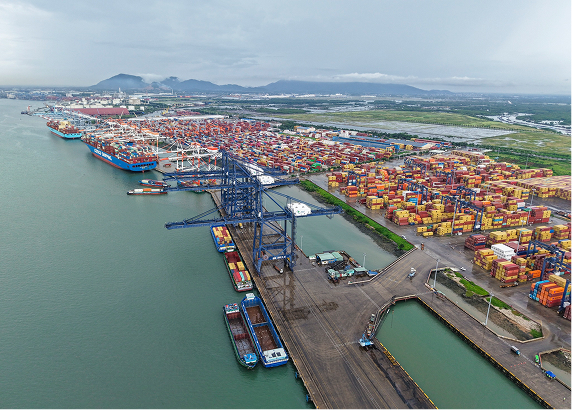
The private sector commands critical industries – manufacturing (electronics and textiles), retail, and logistics – while leading export-oriented ventures that integrate Vietnam into global supply chains. Foreign-invested private firms contribute over 77% of exports, which reached 475 billion in 2025. The sector’s shift from state-led enterprises to private-led innovation has boosted its GDP share to 51%, showcasing its adaptability and capacity for sustainable growth.

Revolutionizing agriculture with innovation

Vietnam’s private sector redefines agriculture, blending tradition with modern, high-value production. Predominantly driven by private households and small enterprises, agriculture accounts for more than 11% of GDP and employs roughly 25% of the workforce (a share that has been gradually declining as the economy shifts toward industry and services). Vietnam is a genuine agricultural export powerhouse: the world’s #1 exporter of cashew nuts ($5.2 billion) and pepper, #2 in coffee ($8.92 billion) and rice (more than 8 million tons exported in 2025), and a top-three global exporter of seafood ($11.3 billion). The country also consistently ranks among the world’s leading exporters of fruits and vegetables (reaching $8.56 billion in 2025) By shifting toward premium, sustainable, and organic products for markets like the US and EU, the sector enhances export value and strengthens rural economies amid urbanization.

Expanding private healthcare

According to FiinResearch, the private healthcare market is projected to grow at 7.5% per year during the 2025-2030 period. Vietnam is targeting 33 hospital beds per 10,000 people by 2025 and 35 by 2030, with the private sector expected to occupy 15% of the overall healthcare system by 2030. This expansion will add substantial new bed capacity, drive modernization, and create attractive investment opportunities in hospitals and related services.

Government support for private-led growth

The government’s steadfast support amplifies the private sector’s strengths, allowing it to play a key role in generating jobs, fostering innovation, and enhancing labor productivity. The centerpiece is a trio of 2025 resolutions: the Politburo’s Resolution 68-NQ/TW (May 4), the National Assembly’s Resolution 198/2025/QH15 (May 17), and the government’s implementation plan, Resolution 139/NQ-CP – together with the 2020 Enterprise Law, these have shifted the policy center of gravity from a state-led economy to private enterprise.

2030 goals: 2 million active companies, 55-58% of GDP contribution, at least 20 large firms deeply integrated into global supply chains, and 10-12% annual sector growth. The government aims to build 20 “national champions” – private companies with US$1-2 billion+ in annual revenue playing first-tier roles in global value chains. Complementing this, the Pioneer Enterprises program (targeting 1,000 firms) offers land incentives, R&D support, easier financing, better market access, and talent development. Looking further to 2045, the vision calls for over 3 million companies contributing more than 60% of GDP, with innovation capabilities ranked among the top three in Southeast Asia and top five across Asia.

A model for inclusive growth

Vietnam’s private sector excels through its skilled workforce, technological innovation, global trade integration, agricultural transformation, healthcare development, and consumer-driven growth. Backed by robust government support, it drives over half of Vietnam’s GDP and sets a compelling example of adaptive, inclusive economic development. As it continues to align with global trends, Vietnam’s private sector is not just an engine of change but a blueprint for sustainable prosperity worldwide.

Foreign Direct Investment in Vietnam

Read more