


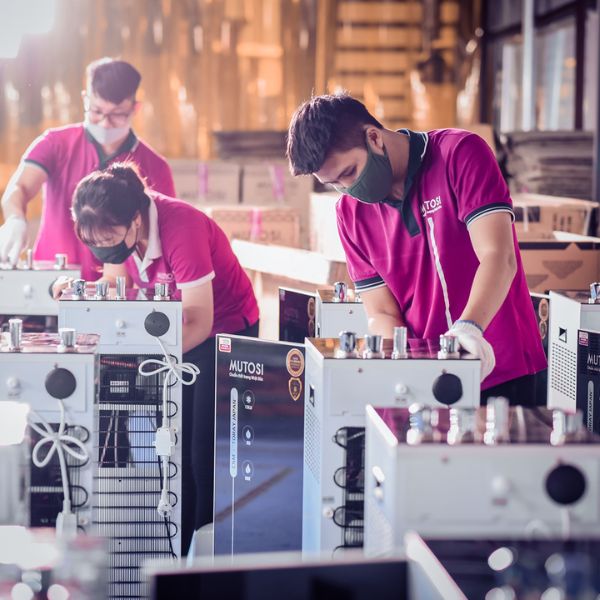

The Turnaround Story of Mutosi
[Shared by Mr. Tran Trung Dung – CEO of Mutosi]

In 2022, Mutosi faced one of the toughest moments in its history. The company was losing around US$4 million a year in 2022 and 2023, despite having invested heavily in talent, systems, and expansion. We had built an organization designed to support VND1.5–2 trillion in future revenue, but actual revenue was only around VND300 billion. It was clear that something fundamental had gone wrong.
Before taking action, we stepped back and diagnosed the business using Michael Rosemann’s Six Core Elements of Business Process Management:
- Strategy – Are we competing in the right way?
- Governance – Are decisions and accountability effective?
- Methods – Are our business processes efficient?
- Information Technology – Are our systems enabling performance?
- People – Do we have the right capabilities and organization?
- Culture – Does the culture support execution and improvement?
The diagnosis was revealing. Governance, systems, processes, and culture were all relatively strong. The two weakest areas were Strategy and People (resources).
Returning to Our Core Competency
Our biggest mistake was moving away from our core competency.
Mutosi had built its reputation in water purification, where we had deep technical expertise, strong industry relationships, and an established distribution network. Yet we had aggressively expanded into home appliances, a category where we had no distinctive competitive advantage.
By 2021, our portfolio had grown to 160 SKUs. Many products lacked a clear unique selling points (USPs), while others were over-engineered, increasing costs without delivering meaningful customer value.
We realized we were trying to compete in too many categories instead of excelling in the ones where we could truly win.
Simplifying to Create More Value
Rather than trying to sell more products, we focused on building better ones.
We conducted extensive market research, in-depth interviews with customers to understand their unmet needs, and benchmarked our competitors. This led us to redefine our product portfolio around three priorities:
- Good product quality.
- Products that genuinely meet customer needs.
- Competitive cost of goods sold.
With those principles in mind, we made one of our boldest decisions: we eliminated more than 100 SKUs, reducing our portfolio from around 160 to just over 50 products.
While competitors such as Kangaroo and Sunhouse offered 400–800 SKUs, we chose to focus on a smaller portfolio that we could optimize for quality, technology, and profitability.
Choosing Profitability Over Market Share
Another critical decision was to stop chasing volume at any cost.
Price competition in modern trade channels such as Dien May Xanh or Cho Lon had become extremely aggressive. We knew that selling more through heavy discounting would only increase our losses.
Instead, we maintained our presence in those channels while focusing on higher-margin, technology-driven products. At the same time, we expanded into new channels such as Shopee and TikTok Shop to diversify our sales mix and reduce dependence on traditional channels.
Building a Leaner Organization
Our second major challenge was resource allocation.
The organization had been built for a business much larger than the one we actually had. We restructured the company by reducing approximately 40% of back-office positions, while investing more in R&D and customer-facing roles. We outsourced seasonal labor, reduced office space, and cut office rental costs by 45%.
Every function was managed through clear KPIs, and resources were allocated according to strategic priorities.
The result was a leaner organization, from 460 employees to around 370 employees, delivering stronger performance with fewer people.
Improving Operational Excellence
As we streamlined the product portfolio, we also had to clear excess inventory to generate the cash flow needed for future investment.
In 2024, we introduced Lean Six Sigma across the organization. Working with experts from Toyota Vietnam, we improved factory processes, reduced waste, and strengthened quality management.
By 2025, these improvements had reduced product costs by around 8% while enabling us to launch products with technologies that could compete with the market’s leading brands.
The Results
Mutosi’s turnaround was gradual but significant. Through disciplined strategic decisions and operational improvements, the company steadily reduced its losses, returned to profitability in 2025, and is on track to achieve even stronger financial performance in 2026.
Key Lesson
The turnaround did not come from launching more products or growing faster. It came from making disciplined strategic choices: returning to our core competency, focusing on products that created real customer value, building a lean organization, and aligning every resource behind the company’s highest priorities.
The most effective strategy is often not adding more, but having the discipline to focus on what you do best and executing it exceptionally well.

Leave a Reply